Natural Clay for Terracotta Facades: From Raw Material to Evidence
See how clay mineralogy, recipe control, forming, drying and firing shape terracotta facade products—and what project evidence should verify performance.
Historical archive: product availability, standards and event information may have changed. Contact LOPO for current specifications.Natural clay is the starting material for architectural terracotta, but the word natural does not establish facade performance, environmental impact or human safety. Clay deposits vary, production recipes can combine several inputs, and firing transforms the shaped body into a ceramic product. A specification therefore needs evidence for the selected product and manufacturing route—not an assumption based on origin alone.
This guide connects raw-material control, forming, drying and firing with the documents a project team should review. The manufacturer controls production; appointed designers define requirements and acceptance.
Natural Clay Is a Variable Raw Material
Clay is not uniform. Mineralogy, chemistry, particle distribution, plasticity, moisture, soluble salts and organics can vary between and within sources, influencing workability, drying, firing, colour and dimensions.
The key question is whether the materials and recipe suit the process and remain controlled. Location alone does not prove suitability; representative sampling, analysis and production records are stronger evidence.
| Control area | Why it matters | Useful project evidence |
|---|---|---|
| Source and incoming material | Variability can change forming and firing behaviour | Approved sources, incoming checks and lot identification |
| Recipe and batching | Proportions affect process consistency and final appearance | Controlled formulation and batch records |
| Grinding, screening and mixing | Particle distribution and uniformity influence extrusion and drying | Process limits, inspection results and equipment records |
| Moisture and ageing | Workability can change with water distribution and preparation time | Defined controls and production logs |
| Drying and firing | Time-temperature-atmosphere conditions transform the clay body | Approved process window, kiln records and release checks |
| Finished product | Geometry, finish and batch must match the submitted item | Product drawing, sample, test reports and traceability |
The Production Recipe May Include More Than One Clay
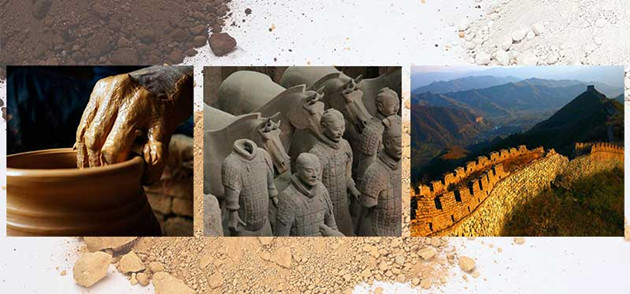
A facade body may blend clays and, depending on the declared product, use water, mineral additions, pigments, process aids or recovered production material. Engobes, glazes and coatings should also be declared rather than hidden behind a generic pure-clay claim.
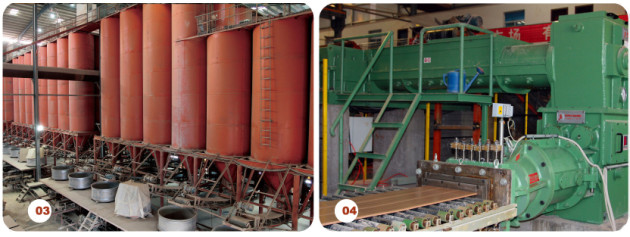
See the LOPO manufacturing and quality-control page for plant context. Current batch records, product documents and inspections must still connect the order to submitted material.
Forming, Drying and Firing Create the Product
Forming establishes the section
Forming creates faces, webs, cavities, grooves and edges. Tool condition, material consistency and process settings affect geometry and appearance; the approved drawing should identify the profile and tolerances required by the fixing concept.
Drying manages moisture and dimensional change
The shaped body dries before firing. Because uneven drying can contribute to distortion or cracking, production controls must suit the selected body, geometry and plant route.
Firing develops the ceramic body
Firing transforms and consolidates the body, with results dependent on process history, composition, section and finish. High-temperature fired is not a performance value; declared characteristics require applicable product-specific evidence.
The terracotta panel product guide shows the range of profiles and finishes that can sit within one material family. That diversity is why evidence should match the item code, section, dimensions, finish, factory and production period where relevant.
Separate Appearance Control from Performance Evidence
Natural-fired terracotta can vary tonally, but acceptance remains a design and quality decision. Agree physical samples, viewing conditions, distribution rules and treatment of outliers; a digital image is not an adequate colour standard.
At the same time, visual approval does not prove structural or weather performance. Review the terracotta facade panel technical-data guide and request reports that clearly identify the product, method, specimen, result, laboratory, date and limitations. The project engineer must decide whether the evidence applies to the proposed spans, fixings, loads and exposure.
Do Not Treat Natural as an Environmental Claim
Environmental assessment should cover extraction, manufacturing energy, yield, waste, packaging, transport, use, replacement and end of life. Natural feedstock can still involve substantial processing; efficiency requires measured, appropriately scoped data.
Use the terracotta environmental evidence guide to review an EPD or LCA. Check the declared product, plant coverage, declared unit, life-cycle modules, geography, data period, verification and validity. Do not transfer a result from another product or factory without a documented basis.
Likewise, natural does not mean free from regulated substances or automatically safe for every use. Obtain the declarations, safety information and compliance evidence required for the product, finish, workplace and jurisdiction.
Build a Traceable Material Submittal
- Identify product code, profile, dimensions, finish, colour range and manufacturing location.
- Describe raw-material sourcing and recipe controls at an appropriate, non-confidential level.
- Provide current drawings, tolerances, declared characteristics and applicable test reports.
- Submit physical samples and an agreed mock-up where appearance or interfaces require it.
- Define batch identification, inspection frequency, nonconformance control and change notification.
- State the scope and limitations of every environmental or regulatory declaration.
If the clay source, recipe, profile, finish or firing route changes after approval, the supplier should notify the designated reviewer. The project team can then determine whether samples, tests, calculations or mock-ups need to be repeated.
Frequently Asked Questions
Is terracotta facade cladding made only from natural clay and water?
Not necessarily. Recipes and finishes vary. Ask the supplier to declare the relevant composition and processing inputs for the selected product rather than relying on a generic description.
Does natural clay make a facade product environmentally friendly?
No. Environmental conclusions require a defined comparison and life-cycle evidence with clear scope. The origin of one input does not represent the impacts of manufacturing, transport, use or end of life.
Can clay source predict the final panel colour?
It can influence colour, but recipe, firing atmosphere, process conditions, finish and accepted production range also matter. Approve representative physical samples and distribution criteria.
What evidence links a test report to my project product?
Check the manufacturer, factory, product code, section, dimensions, finish, specimen preparation, test method, date and report limitations. The appointed professional should confirm applicability.
Request Current Material and Process Evidence
Send the intended profile, dimensions, finish, colour concept, quantity, project location and required declarations through the LOPO project enquiry page. Ask for current evidence tied to the proposed product; final specification and compliance decisions remain with the project team.