Beijing Palace: Orange Terracotta Facade Case
Explore Beijing Palace, the Beijing Hotel Phase II complex, through its orange terracotta facade, verified project data and three original images.
Historical archive: product availability, standards and event information may have changed. Contact LOPO for current specifications.Beijing Palace, also documented as Beijing Hotel Phase II, is the orange-screened building beside Wangfujing in central Beijing. Its terracotta facade was publicly revealed in July 2010. Contemporary reporting and a curtain-wall project portfolio provide unusually specific figures for the building and its envelope.
This is an architectural precedent, not a verified LOPO-supplied project. A contemporary Chinese report says all of the orange panels were imported from Spain, and no checked record gives LOPO a manufacture, supply or installation role. That distinction is essential to an accurate case study.

Verified Project Record
| Field | Supported record | Evidence boundary |
|---|---|---|
| Project | Beijing Palace, 北京宫; Beijing Hotel Phase II | Independent contemporary report and curtain-wall portfolio |
| Location | Beside Wangfujing, Dongcheng, Beijing | Site context; not a postal work address |
| Facade reveal | 7 July 2010 | Contemporary report; not a full construction chronology |
| Building | 270,000 m², 34.85 m high, eight floors | Published project figures |
| Terracotta portion | Approximately 53,000 m² and more than 230,000 panels | Reported figures, not a LOPO supply schedule |
| Total curtain wall | 69,280 m² | Includes terracotta, glass and cable-net systems |
| Panel forms | More than 200 flat, grooved, convex, concave and artistic forms | No approved item schedule found |
The 2018 WordPress publication date is not the project year. The strongest chronological record is the contemporary report that the completed facade was revealed on 7 July 2010.
Why 53,000 m² and 69,280 m² Can Both Be Correct
The two area figures describe different scopes. Contemporary coverage assigns about 53,000 m² to terracotta-panel curtain wall. The specialist portfolio gives 69,280 m² for the project’s entire curtain wall and lists framed terracotta, framed glass and cable-net glazing.
Accordingly, 53,000 m² should not be labelled total envelope area, and 69,280 m² should not be labelled all terracotta. The difference is consistent with non-terracotta curtain-wall zones. Neither number identifies LOPO supply, package value or installed panel count by elevation.
Orange Terracotta Shapes the Urban Screen
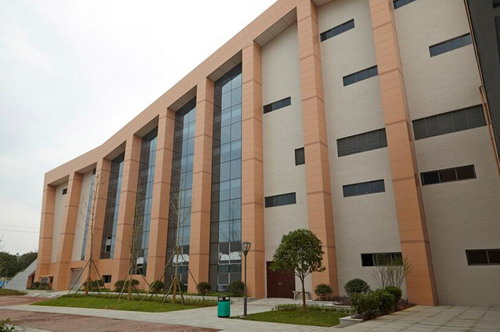
The direct photograph shows an expansive orange field wrapping a low, broad volume. Repeated vertical slots and framed openings break down the mass, while setbacks and projecting bands add depth. The screen contrasts with the pale, more vertically expressed historic hotel nearby.
The reported palette includes flat, grooved, convex, concave and artistic forms. That variety helps explain the changing shadow lines, but the small photograph cannot map form types to individual zones. See the terracotta panel overview for current category context, not as a retrospective product schedule.
Material and Supplier Boundaries
The safe material description is orange terracotta panel within a framed curtain-wall system. It should not be reduced to generic orange tile, solid brick masonry or an adhered brick veneer. Each term implies a different body, format and support method.
Most importantly, the contemporary source reports that all orange panels were imported from Spain. No contract, delivery record, approved sample, product code or credible project document connects the panels to LOPO. The page therefore analyses a public architectural precedent rather than claiming LOPO manufacture or supply.
A general terracotta panel design guide can help frame current questions, while the terracotta panel installation overview illustrates category concepts. Neither source proves how this historic facade was detailed.
What the Three Images Actually Prove


Only the featured image directly documents the orange facade. The other two establish the neighbouring hotel’s scale and city setting. None reveals rails, brackets, anchors, cavity depth, insulation, fire stopping, drainage, movement joints or replacement strategy. They also cannot validate quantity or performance.
Build a Current Panel Brief From Verified Inputs
- confirm the current panel body, forming method, finish, colour range and available formats;
- set out every flat, grooved, curved and special unit against coordinated elevations;
- define rails, brackets, anchors, joints, cavity, insulation and water-management interfaces;
- coordinate openings, corners, parapets, bases and transitions to glass curtain wall;
- identify applicable structural, fire, thermal, moisture and durability evidence; and
- approve representative visual and technical mock-ups before production.
The broader terracotta panel project archive offers comparison cases, but each project needs its own verified schedule, calculations, approvals and supply record.
Evidence and Performance Limits
No approved panel dimension was found. A 500 × 1200 mm value appears in an unattributed repost, so it is excluded rather than promoted as project data. There is likewise no verified item number, panel thickness, module map or current availability.
The old no-light-pollution conclusion is also removed. Colour and matte appearance alone cannot establish glare, reflectance or environmental performance. No checked project report supports fire, wind, thermal, acoustic, water, colour-retention, durability or maintenance claims.
Frequently Asked Questions
Is Beijing Palace the same project as Beijing Hotel Phase II?
Yes. Independent project records use Beijing Palace and Beijing Hotel Phase II for the orange-clad development beside Wangfujing.
Did LOPO supply the orange terracotta panels?
No checked evidence establishes that. Contemporary reporting says all orange panels were imported from Spain, so this page must remain an architectural precedent rather than a LOPO supply claim.
How much of the facade uses terracotta?
A contemporary report gives approximately 53,000 m² of terracotta curtain wall. A separate 69,280 m² figure covers all curtain-wall types, including glass and cable-net systems.
What panel sizes and item codes were used?
They are not verified. No approved schedule was found, and a dimension repeated by an unattributed repost is not used.
Discuss a Current Terracotta Facade
For a new project, send elevations, target appearance, climate, support concept and required evidence through the LOPO project enquiry page. Product selection, engineering, testing, approval and supply scope must be established for that project.