
LOPO Terracotta: Products, Manufacturing and Project Support
Learn about LOPO Terracotta’s Fujian factories, architectural clay products, manufacturing approach, customization and support for global facade projects.
LOPO Terracotta is a China-based manufacturer and supplier of architectural fired-clay products for facades, walls and landscape applications. Established in 2002, the business focuses on terracotta panels, baguettes, bricks, tiles, mosaics, special-shaped units and related facade components for project use.
LOPO works with architects, facade consultants, contractors, distributors and project buyers. Its role is to review product feasibility, manufacture and supply the specified units, coordinate samples and mockups, and support production and delivery. Architectural design, final system engineering and local code approval remain the responsibility of the project’s qualified professionals.
LOPO Terracotta at a glance
| Established | 2002 |
|---|---|
| Business focus | Architectural terracotta products and project supply |
| Terracotta panel factory | Yintang, Changtai, Zhangzhou, Fujian, China |
| Terracotta brick and tile factory | Guanqiao, Nanan, Quanzhou, Fujian, China |
| Primary customers | Architects, facade contractors, builders, distributors and project buyers |
| Project support | Feasibility review, samples, mockups, production coordination, quality checks, packing and delivery planning |
Architectural terracotta product range
Terracotta facade panels
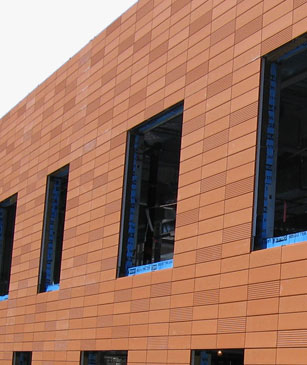
Extruded terracotta panels create the visible outer layer of ventilated rainscreen facades. Projects can vary the module, orientation, body color, surface and joint rhythm. Panel profile, thickness, support spacing and fixing method must be coordinated with project loads and the complete wall assembly. Explore the LOPO terracotta panel range.
Terracotta baguettes and louvers
Baguettes are linear fired-clay elements used for solar shading, screens, fins, balustrade zones and visually open facades. Rectangular, square and project-specific profiles can produce different levels of transparency and shadow. Span, reinforcement, end fixing and wind load require project-specific review. See terracotta baguettes and louvers.
Terracotta bricks and brick slips
Architectural clay bricks and thin slips provide the depth, bond pattern and natural variation associated with fired masonry. They can be used for new facades, feature walls and renovation, subject to the selected product and installation system. Corners, returns, joints and movement provisions should be detailed before quantities are finalized. View terracotta bricks and clinker brick slips.
Terracotta tiles, mosaics and special shapes
Solid tiles, mosaics and custom units can address smaller modules, curves, soffits, entrances and detailed surfaces. Suitability depends on exposure, substrate, fixing or adhesive system and product-specific performance. Special-shaped pieces may require tooling, prototypes and a separate production schedule.
The architectural terracotta collection provides an overview of the main product families, while the item listing helps project teams review available profiles and formats.
How architectural terracotta is made
Manufacturing begins with the selection and preparation of clay. The body is formed—commonly by extrusion for panels, baguettes and many bricks—then carefully dried before firing. The firing cycle develops the final color, strength and surface character. Glazing, texturing, cutting or other finishing steps are applied according to the product and project specification.
Large or deep profiles require control through forming, drying and firing because clay changes dimension during production. This is why a proposed shape cannot be judged only from a drawing. The manufacturer must review extrusion geometry, wall sections, tolerances, handling and kiln behavior before confirming feasibility.
Color, texture and customization
Terracotta color comes from the clay body, firing conditions and any applied glaze or surface treatment. Natural-fired products can show controlled shade variation, which is part of the material character. Textures such as smooth, grooved, combed, sanded or relief surfaces alter both appearance and the way light moves across a facade.
Customization may include module, profile, color direction, texture and special pieces, but every request is subject to manufacturing and engineering limits. For major projects, LOPO recommends a staged approval process: initial color references, representative samples, prototype units where required and a full-size visual mockup before mass production.
Quality control should be product-specific
“Terracotta” describes a material family, not one fixed level of performance. Relevant checks can include dimensions, straightness, flatness, appearance, water absorption, breaking load, frost resistance or other properties required by the project. The necessary evidence depends on the exact product, thickness, profile, fixing system and destination market.
Project teams should request current test reports that match the proposed configuration and clearly identify the applicable standard and test scope. A result for one panel or brick should not be presented as universal proof for every LOPO product.
Learn more about the two production bases on the LOPO manufacturing and quality page.
From design intent to delivered product
- Initial review: provide project location, drawings, desired product, dimensions, finish and estimated quantity.
- Feasibility: review profiles, modules, special pieces, installation concept and relevant manufacturing limits.
- Samples: select representative colors and surfaces; develop project-specific samples or tooling where necessary.
- Mockup: confirm scale, joint appearance, corners, interfaces and acceptable color range.
- Production: freeze approved references, quantities, cutting schedule, packing marks and delivery batches.
- Quality and logistics: inspect the agreed characteristics and coordinate packing, documents and shipment sequence.
Clear early information produces a more reliable quotation and reduces changes later. To start a review, send LOPO the project drawings, product requirements, quantity and delivery destination.
Frequently asked questions
Does LOPO provide architectural design?
LOPO manufactures and supplies terracotta products and can assist with product feasibility, samples and production coordination. The building design, facade engineering and local compliance should be completed by the project’s appointed professionals.
Can LOPO make custom terracotta profiles?
Custom development is possible for many projects, subject to extrusion, drying, firing, structural and quantity considerations. Drawings are required before feasibility and tooling can be confirmed.
What information is needed for a quotation?
Send the product type, dimensions, surface, color direction, quantities, drawings, required tests, delivery location and target schedule. Mark special pieces separately.
How should a project approve terracotta color?
Use physical samples and agree on a representative range rather than a single digital image. A full-size mockup is recommended for large or visually sensitive facades.


