
Terracotta Facades for Education Buildings: Six Archive Records
Six historical school, university, museum and library facade entries are reorganized as an evidence-led reference. Conflicting project fields and uncertain image mappings are shown instead of being silently merged.
Historical archive: product availability, standards and event information may have changed. Contact LOPO for current specifications.This archive brings six education-building terracotta records into one evidence-led reference. The source names two middle schools, a school in Qingdao, an older-adult university, a children’s science and technology museum, and a university library. It also lists historical item references, nominal dimensions and time fields.
Those entries are useful for comparison, but they are not six complete specifications. The page supplies no project teams, quantities, test reports, system drawings or acceptance records. Later LOPO pages also conflict with two of the entries and their photographs. This revision keeps the record visible without smoothing over those gaps.
Six Historical Project Entries
| Archive record | Time and product fields | Use boundary |
|---|---|---|
| Jinjiang No.1 Middle School | 2012; F3018003, F3018635, F4518003, F4518635; 300/450 × 900 × 18 mm | Source fields; no quantity or completion proof |
| Yucai Middle School, Qingdao Economic Development Zone | 2013; FW6018217, F3018003; multiple listed widths and 300 × 900 × 18 mm | Conflicts with the later dedicated case |
| Qingdao Xin’an Weiming School | 2013; F4521634, F45210031, F4521889; 450 × 900 × 21 mm | Single archive schedule, not current confirmation |
| Nanchang College for the Senior | 2014; F4521634, F4521637; 450 × 900 × 21 mm | Dedicated case uses a different English name and image set |
| China Children’s Science and Technology Museum | 2015; F3020768, T40100768; 300 × 900 × 20 mm | The source does not explain which size applies to which product |
| Hebei University Library | 2015; F3322637; 330 × 900 × 22 mm | Special-shaped panel description lacks drawings or scope |
The years are labelled “Time” in the old article. They may refer to a project, supply or publication context; they should not automatically become completion dates. The item codes and dimensions are likewise historical fields. A current selection must use dated data for the exact terracotta panel or linear element under consideration.
Named-Project Ownership and Conflicting Schedules
The later Qingdao Yucai project case has five coherent photographs and a different set of item references, dimensions and date context. It should own the named-project query. The two schedules must remain separate until a delivery file or drawing register proves whether they describe different phases, buildings or an older error.
The Nanchang Senior-Citizen University case repeats the two item references and module but adds two coherent project images and other archive fields. That dedicated page owns the Nanchang query. Post 5738 remains the cross-project comparison, while the separate university terracotta facade guide covers Shingu and the record called XM University rather than duplicating these six.
What the Images Can Establish


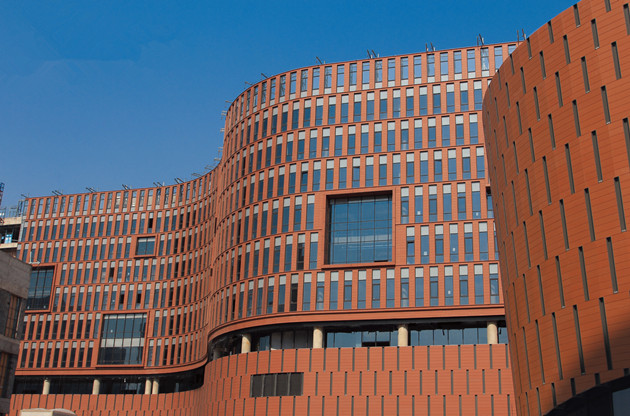
Together, the files show several visible design moves: warm and pale colour zoning, long horizontal bands, window-bay grids, glazed centres and variations in panel rhythm. They do not show anchors, rails, membranes, fire barriers, drainage paths or structural calculations.


How to Use an Education-Facade Reference
A precedent should help define questions, not preselect an assembly. Designers can compare colour distribution, module rhythm, screen depth and the relationship between solid areas and glazing. The project team must then translate those intentions into measurable criteria for the actual climate, height, occupancy, fire strategy and jurisdiction.
- Confirm each reference image against a named building and elevation.
- Separate visual inspiration from tested product and system performance.
- Issue current samples, colour-range limits and interface drawings.
- Define loads, impacts, fire requirements, tolerances and movement.
- Assign responsibility for calculations, testing, installation and inspection.
Because these records span schools, a museum and a library, their operational questions are not identical. A busy ground-level school elevation may need a different impact and replacement strategy from an upper library facade. A screen near glazing raises different access, daylight and cleaning questions from a solid panel wall. Public entrances, escape routes, teaching spaces and collection areas may also drive distinct interface and inspection priorities. The architect and specialist consultants should document those differences before any reference product, module or joint pattern is adopted.
Schools also require careful planning around entrances, play areas, service routes and accessible replacement zones. Whether a panel, baguette or special shape is appropriate depends on the project brief and engineered system, not the education label alone.
Frequently Asked Questions
Are the six time fields verified completion years?
No. They are archived “Time” entries. Use them as historical labels until a dated project record establishes the milestone they represent.
Why do the Yucai records disagree?
The roundup and later dedicated article list different dates, items and dimensions. They may describe phases or contain legacy errors; no reviewed source reconciles them, so the schedules remain separate.
Can the Nanchang image in this roundup be relabelled?
Not safely. The file placed after Nanchang shows a different building from the dedicated case images. Preserve it as unassigned archive media until a captioned source resolves the identity.
Do these examples prove facade performance?
No. Photographs and item codes do not prove structural, fire, water, thermal, acoustic or durability performance. The responsible project team must specify evidence and acceptance criteria.
Prepare a Current Education-Facade Enquiry
Send building type, location, elevations, target appearance, interface details, performance criteria and programme—not only a reference photograph. Contact LOPO with the current brief so samples and product data can be reviewed within a defined project scope.


