
What Is Architectural Terracotta? A Practical Introduction
A practical introduction to architectural terracotta: facade panels, baguettes, manufacturing, applications, design limits and specification questions.
Historical archive: product availability, standards and event information may have changed. Contact LOPO for current specifications.Architectural terracotta is a broad term for fired-clay products made for buildings and designed to perform as part of an architectural element or construction system. Modern examples include rainscreen panels, baguettes and louvers, solid wall tiles, bricks, breeze blocks, mosaics, and specially shaped pieces. Their role may be protective, decorative, functional, or a combination of all three.
The term describes a material family rather than one universal product. A terracotta facade panel, a sunscreen baguette, and a solid brick differ in geometry, fixing, testing, and suitable applications. Good specification therefore starts by identifying the product’s intended role in the building.
Architectural Terracotta in Modern Buildings
Contemporary architectural terracotta is commonly used to add durable fired-clay color, texture, and shadow to exterior and interior surfaces. On facades, panels may form the visible outer layer of a ventilated rainscreen. Linear baguettes may create screens, fins, or sun-shading features. Solid tiles and bricks may be installed as wall finishes or masonry elements, depending on the product and project design.
LOPO’s architectural terracotta product overview shows how these product families serve different design intentions. They should not be treated as interchangeable simply because they are all made from fired clay.
How It Differs from Historical Terra Cotta
Historical architectural terra cotta often refers to molded or pressed units used for cornices, ornament, sculptural details, and glazed facade elements on older buildings. Restoration work may require a close reproduction of the original shape, glaze, color, body, and anchoring arrangement. That is a specialist conservation task and should be based on a survey of the existing building.
Modern architectural terracotta is frequently designed as a repeatable component within a documented facade or wall system. Extruded panels and linear profiles can create regular modules, open screens, deep reveals, and textured surfaces. Modern products may also be used in renovation, but they are not automatically direct replacements for historic units. Existing structure, moisture, corrosion, anchors, movement, and heritage requirements must be evaluated by qualified professionals.
Common Product Forms and Their Roles
| Product form | Typical architectural role | Key coordination questions |
|---|---|---|
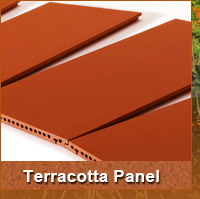
| Hollow facade panel | Outer cladding layer in a ventilated or rainscreen facade | Panel module, support system, joints, corners, loads, and replacement access |
| Baguette, louver, or fin | Screening, shading, visual rhythm, or decorative linear element | Section, span, orientation, support points, wind effects, and alignment |
| Solid tile or brick slip | Wall finish for selected exterior or interior applications | Substrate, adhesive or dry fixing, joints, moisture exposure, and edge details |
| Brick or breeze block | Masonry expression, open screen, ventilation, or daylight filtering | Structural role, mortar, reinforcement, movement, exposure, and local code |
| Mosaic or special-shaped piece | Detailed surfaces, feature walls, transitions, corners, or custom geometry | Repeat pattern, backing, tolerances, installation method, and maintenance access |
For projects centered on a ventilated building envelope, see the dedicated terracotta facade panel information. Projects using open linear screens can review terracotta baguette and louver systems.
How Architectural Terracotta Is Made
The exact process depends on the product, but production generally begins with selecting and preparing a clay body. The material is formed into the required section or shape, carefully dried, and then fired. Products may retain a natural-fired surface or receive a glaze, texture, printed decoration, or another project-specific treatment. Cooling, sorting, dimensional checks, visual inspection, and packing follow.
Drying and firing are important because clay changes during production. Profile design, dimensions, surface treatment, kiln conditions, and quality-control criteria must be coordinated rather than considered separately. LOPO’s manufacturing and quality-control overview provides further context, while the requirements for an actual order should be recorded in its drawings, samples, and agreed inspection documents.
Design Benefits and Necessary Qualifications
- Material character: Fired clay can provide depth, texture, and controlled tonal variation that differs from a printed coating.
- Design range: Different product families support flat cladding, deep profiles, open screens, masonry patterns, and detailed surfaces.
- Replaceable components: Some mechanically fixed systems allow individual pieces to be removed, subject to the system design and access.
- Stable finish: Suitable fired or glazed surfaces can provide long-term exterior finishes, but performance must be confirmed for the selected product and exposure.
These benefits should not be converted into blanket claims. A panel alone does not determine a wall’s thermal value, fire performance, acoustic performance, water management, or structural capacity. Those results depend on the complete assembly, relevant test evidence, detailing, installation, and local regulations. Environmental statements likewise require defined boundaries and product-specific information; terms such as zero-carbon, maintenance-free, or fully recyclable should not be used without evidence and context.
What to Confirm Before Specification
- Identify whether the material is cladding, screening, masonry, flooring, or an interior finish.
- Confirm the product format, orientation, surface, color range, joints, corners, and visible edges.
- Coordinate loads, supports, anchors, substructure, movement, drainage, ventilation, and replacement access.
- Request test information that is relevant to the selected product rather than a different profile or generic material.
- Approve representative samples and, where appropriate, a larger mock-up under realistic lighting and viewing conditions.
Frequently Asked Questions
Is architectural terracotta a type of ceramic?
Yes. Terracotta is a fired-clay ceramic material. The architectural term indicates that the product has been developed for a building application, but its exact body, profile, finish, fixing, and performance still need to be identified.
Can architectural terracotta be used outdoors?
Many products are intended for exterior use. Suitability depends on the selected item, climate, exposure, fixing or bedding system, test evidence, detailing, and local requirements. An interior terracotta product should not be assumed suitable for a facade.
Are custom colors and profiles possible?
Project-specific development may be possible, subject to manufacturing feasibility, quantity, schedule, profile geometry, sample approval, and performance requirements. Early discussion is important because appearance and engineering decisions affect one another.
Is color variation a defect?
Not necessarily. Controlled variation is characteristic of fired clay. The project team should approve a representative color range and define how pieces will be assessed and distributed, rather than relying on one small sample.
Does a terracotta facade require engineering?
Yes. Product information from the manufacturer supports coordination, but project-specific loads, brackets, anchors, rails, joints, substructure, and local compliance require review and approval by qualified facade and structural professionals.
Discussing an Architectural Terracotta Application
A useful enquiry should include the application, drawings, dimensions, target finish, estimated quantity, required schedule, and delivery destination. Submit these details through the LOPO project enquiry page so the appropriate product family and next review steps can be discussed.


