Terracotta vs Other Facade Materials: Selection Brief
Compare terracotta with other facade materials using a quick design brief covering appearance, module, support, detailing, evidence and project priorities.
Historical archive: product availability, standards and event information may have changed. Contact LOPO for current specifications.Terracotta vs other facade materials is not a contest with one universal winner. The useful choice depends on the desired expression, facade role, module, geometry, support strategy, climate, maintenance plan, evidence requirements, budget and programme. This quick brief helps a design team decide which material families deserve deeper study.
Use it at concept or early schematic stage. It is intentionally a first-pass framework rather than a detailed performance ranking. Once the shortlist is clear, compare product-specific test documents, system details, samples, mock-ups, suppliers and whole-life implications on an equivalent basis.
Compare the Same Facade Function
First define what is being compared. An opaque ventilated rainscreen panel, a glazed curtain wall, a stone veneer and a formed metal cassette may occupy similar elevations but perform different roles. Do not compare the weight, cost or performance of one exposed panel with a complete alternative wall assembly.
Record the required weather line, insulation, air and vapor control, cavity, substructure, fire strategy, joints, openings and interfaces. The visible material is only one layer. For terracotta options, the LOPO architectural terracotta overview helps distinguish panels, baguettes, solid tiles, bricks and other clay units before comparison begins.
Set Priorities Before Naming a Material
| Design priority | When terracotta may suit the brief | When to study another option closely |
|---|---|---|
| Material character | The design seeks fired-clay color, texture, shadow and modular repetition | The concept depends on transparency, mirror-like reflection, metallic folding or exposed aggregate |
| Facade module | Panel, tile or linear clay modules can coordinate with openings and joints | The elevation requires very large seamless fields or continuously changing sheet geometry |
| Depth and relief | Extruded profiles, grooves, textures and baguettes can create a layered elevation | The form requires deep monolithic casting or highly folded thin sheet |
| Support concept | A mechanically fixed, replaceable rainscreen layer fits the wall strategy | Structure, spans, substrate or access favor a different lightweight or bonded solution |
| Visual variation | A controlled range of fired-clay tone is welcome in the design | The brief requires tightly uniform color or a finish best achieved with another process |
| Evidence and approvals | Applicable product and system information can support the intended use | Another system has a clearer route for the project’s unusual geometry, exposure or jurisdiction |
Use Material Snapshots to Build the Shortlist
Terracotta
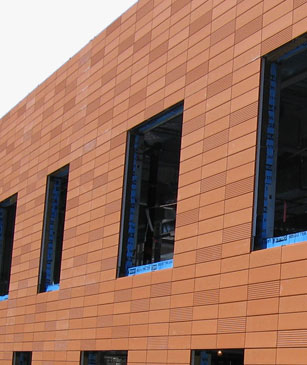
Terracotta offers a ceramic surface, modular joints and options ranging from hollow rainscreen panels to linear baguettes and solid tiles. Color, glaze, profile and texture can be design inputs. The team should coordinate unit size, joint rhythm, edge conditions, replacement access, support rails and acceptable tonal range. Review the terracotta facade panel range when the application is an opaque ventilated rainscreen.
Metal
Metal sheets, cassettes and extrusions can support crisp folds, broad color systems and relatively thin profiles. Check alloy or substrate, coating, flatness, oil-canning expectations, corrosion at interfaces, dent risk, thermal movement and repair strategy. The chosen metal system should be compared as a complete assembly, not only by skin thickness.
Natural Stone
Stone can provide distinctive veining, mineral character and project-specific slab patterns. Its selection requires attention to quarry variation, slab direction, anchors, edge distances, movement, replacement matching and the suitability of the selected stone for its exposure. A generic stone sample does not establish the properties of every block or finish.
Glass
Glass is central when daylight, views, transparency or controlled reflectivity drives the facade. The comparison must include framing, spandrels, coatings, shading, thermal design, safety, glare, bird-friendly measures where required and maintenance access. An opaque terracotta rainscreen and a vision-glass wall should not be treated as interchangeable layers.
Concrete, GFRC and Cast Elements
Cast materials may suit deep relief, large bespoke forms or a monolithic expression. Review unit geometry, reinforcement, connections, joints, water management, finish consistency, cracking expectations, transport and erection. Their structural and installation logic differs from a modular ceramic rainscreen.
Fiber Cement, Laminates and Composite Panels
These product families can offer flat sheets, varied finishes and efficient modules. Composition and performance vary widely, so avoid judging them as one material. Check the exact product, core or substrate, surface, edge treatment, fixing system, fire strategy, weathering evidence and replacement route.
Follow a Fast Early-Design Workflow
- Write the facade brief. Define opaque and glazed zones, visual intent, module, geometry, exposure, access and required service strategy.
- Choose comparable assemblies. Include substructure, cavity, membranes, insulation, flashings, joints and fixings where relevant.
- Shortlist material families. Use the priority table to remove options that cannot deliver the central design intent.
- Identify candidate products. The LOPO item listing can establish terracotta candidates; obtain equivalent information for alternatives.
- Request evidence and samples. Compare the exact products, not generic material claims.
- Build and review a mock-up. Examine color, texture, joints, corners, interfaces, drainage and installation tolerances under representative light.
Ask Questions That Expose the Real Trade-offs
- Which visual quality is essential, and which is only a preference?
- Can the proposed module coordinate with windows, corners and movement joints?
- What supports the cladding, and how are loads transferred to the building?
- Which layer manages water, air, heat and vapor?
- How can damaged units be inspected, accessed and replaced?
- What product and system evidence is required for this location?
- How will samples, variation and the final mock-up be approved?
- Do procurement lead times and specialist installation suit the programme?
If the design uses linear screening or shading, inspect the terracotta baguette range separately. Its spans, orientation, fixings and loads require a different review from wall panels.
Frequently Asked Questions
Is terracotta better than metal or stone for every facade?
No. Terracotta may suit a clay-based, modular rainscreen expression, while metal, stone, glass or cast materials may better serve other priorities. Compare defined systems against the same brief.
Can facade materials be compared by product price alone?
No. Include substructure, fixings, special pieces, engineering, testing, logistics, installation, access, maintenance and replacement. Confirm project-specific prices rather than assuming a generic ranking.
Does terracotta provide the building’s thermal performance?
The complete wall determines thermal performance. The cladding, cavity, insulation, membranes, structure, glazing and interfaces must be assessed together for the actual climate and design.
When should the design team request samples?
Request samples after the intended product family and appearance are defined, then progress to a representative sample set or mock-up before final approval. Record the accepted range and viewing conditions.
Turn the Brief into a Comparable Enquiry
Send the facade role, elevations, sections, target module, appearance, quantity, location, programme and required documents through the LOPO project enquiry page. A clear brief allows terracotta to be evaluated against other facade materials on the priorities that actually shape the project.